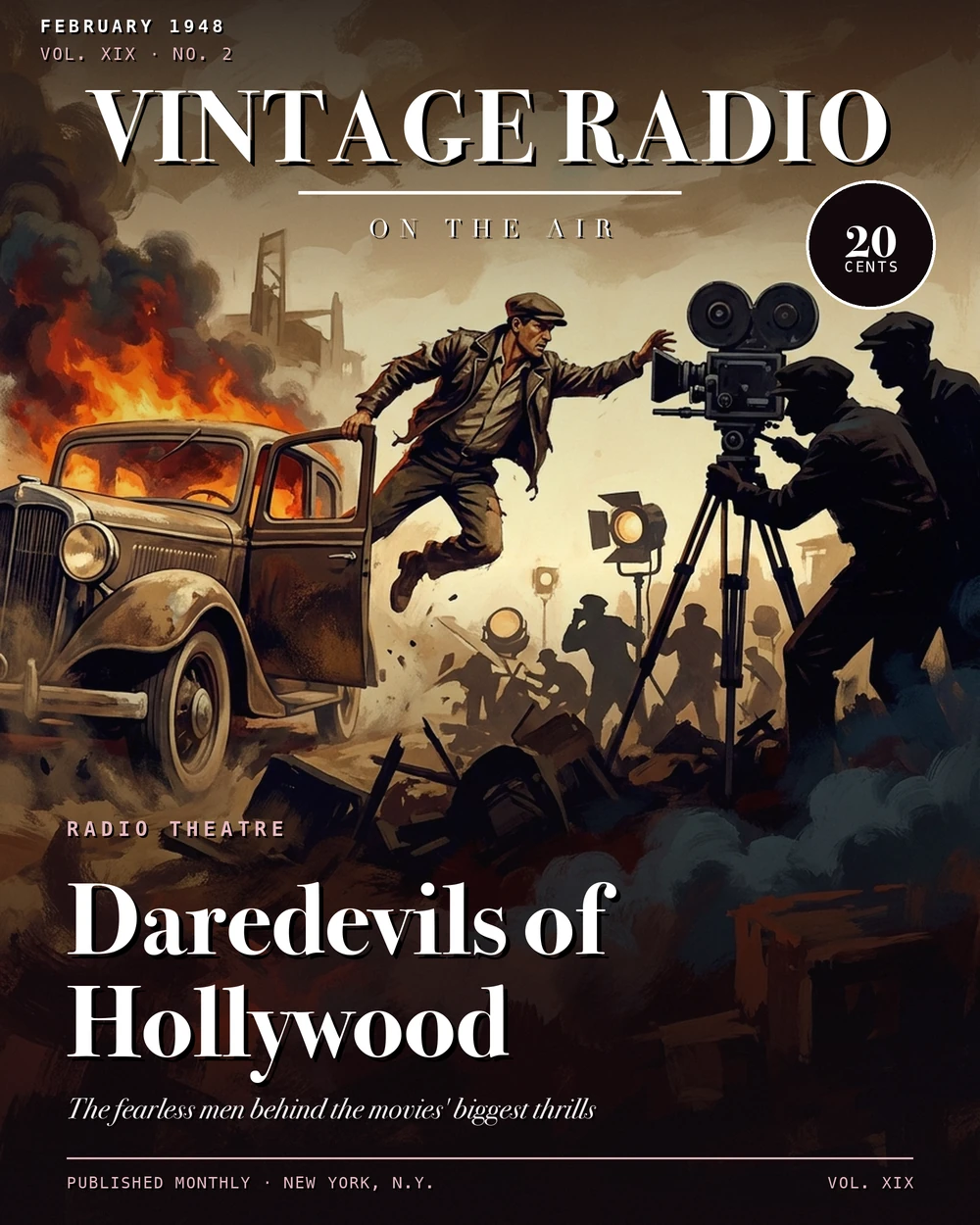
Daredevils of Hollywood
The Show That Gave Stuntmen a Voice
Long before stunt coordinators received screen credits or awards ceremonies celebrated their craft, the people who fell off horses, crashed cars, and jumped from burning buildings were largely invisible to the audiences who thrilled at their work. Daredevils of Hollywood changed that, at least for one radio season. Launching on April 25, 1938, this syndicated series devoted each episode to a single Hollywood stunt performer — their background, their training, their most dangerous work — and put the real names and real stories in front of listeners who had probably never thought to ask who actually did the things they'd just seen on screen.
The format was deceptively simple: one performer, one episode, one portrait. Episode titles were just the performer's name — "Yakima Canutt," "Cliff Lyons," "Eileen Goodwin" — which made clear from the start that this wasn't a dramatization but a genuine profile series. Radio actors Frank Nelson and Earle Ross served as on-air hosts and narrators, guiding listeners through each performer's story. Hanley Stafford, a prolific radio character actor, also appeared in connection with the series, though his precise role isn't specified in the available record. The scripts were credited to writer Kurt Forman, whose name appears on at least the Cliff Lyons episode, which originally aired on April 29, 1938, just four days into the run.
The People It Profiled
The performers who turned up in the episode lineup represented a real cross-section of what Hollywood stunt work looked like in the late 1930s. Yakima Canutt was probably the biggest name in the bunch. By 1938 he had worked on more than two hundred films and had been named Republic Pictures' head stunt coordinator. His signature stagecoach stunt — leaping from the coach onto the rear pair of a six-horse team, working forward horse by horse, then dropping beneath the hooves and hauling himself back up — was reportedly worth $1,000 per performance, a serious sum for the era.
Cliff Lyons was a South Dakota-born rodeo rider who had made the transition into Hollywood stunt work and second-unit directing. He had started working with John Wayne just two years before the show aired and would go on to become one of the key stuntmen associated with John Ford's westerns. The aerial side of the industry showed up in the episode on Frank Clarke — spelled "Frank Clark" in the episode listing, a variant that reflects the fact that Clarke added the final "e" to his surname at some point in his career. He was Hollywood's leading aerial stunt pilot of the period, with work going back to Howard Hughes' Hell's Angels in 1930. He died in a non-film-related plane crash in 1948.
The show didn't limit itself to the most famous names. Episodes on Matt Gillman, Slim Talbot, Bob Rose, Ken Cooper, Lone Reed, and Gordon Carveth rounded out the roster alongside the headliners. Gillman's episode described a 1933 stunt in which he raced his car against a locomotive to a railroad crossing. Talbot's covered a 1937 job that went memorably wrong — or right, depending on how you look at it — when two wheels fell off a stagecoach he was riding simultaneously. And the inclusion of Eileen Goodwin in the lineup reflected the real history of the profession: stunt women had been part of early Hollywood since the silent era, and the show treated them as belonging in the same conversation as their male counterparts.
How It Was Made and How It Survived
Daredevils of Hollywood was a syndicated program, not a network production, which meant it didn't run on a single schedule across the country the way a CBS or NBC show would have. The series ran from April 25, 1938 through at least July 22, 1938 — roughly thirteen weeks. The episodes covered subjects ranging from high falls and car stunts to the choreography and planning that went into making dangerous sequences work without killing anyone. Each profile aimed to help listeners understand not just that a stunt happened, but why it was difficult, what preparation it required, and what kind of person it took to do it.
The surviving episode count is somewhat uncertain. The catalog holds around 20 known episodes, but at least 26 recordings appear to exist in total, running approximately five hours and twenty-five minutes combined — which suggests the full run may have been somewhat longer than what's currently cataloged. A curation effort on the series in June 2009 helped establish what was actually in circulation and what condition the recordings were in.
Why It Holds Up as a Document
What makes Daredevils of Hollywood interesting now isn't just that it's an entertaining piece of radio from 1938. It's that it captured a working world at a specific moment of transition. The stunt profession had been evolving rapidly since the late 1920s, when the arrival of sound film and studios' growing interest in protecting expensive contracted talent pushed the industry toward specialists who did dangerous work on behalf of actors. By 1938, figures like Canutt were already established professionals with long careers and recognized expertise. The show's format — biographical, interview-adjacent, focused on craft and preparation — treated stunt performers as skilled workers worth understanding, not just as anonymous spectacles.
The profiles of specific stunts give the series its texture. Knowing that Canutt's stagecoach gag paid $1,000 a take, or that Talbot's two-wheel episode described something that actually happened on a real production in 1937, makes the episodes concrete in a way that a generalized adventure program never could be. These weren't invented scenarios. They were recent professional history, described by or about the people who had actually done the work.
For a program that ran on a syndicated schedule in the spring and summer of 1938 and wrapped before the year was half over, Daredevils of Hollywood preserved a remarkable amount of detail about a profession that wouldn't get much sustained public attention for decades to come.